ricerca
The STEVE Phenomenon and SAR Arcs: When the Sky Doesn't Show a Classic Aurora
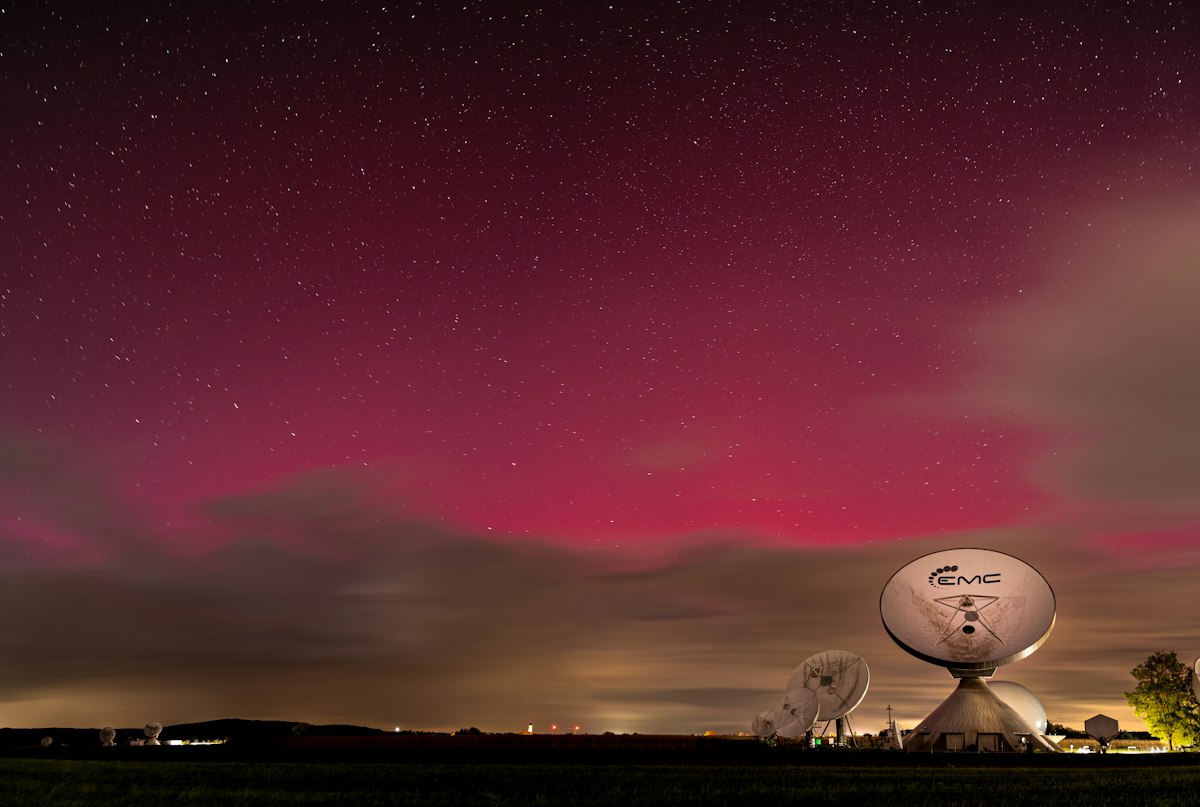
Until 2016, Canadian night photographers often captured a mysterious purple ribbon in the sky, positioned much further south than the classic auroral oval. They affectionately called it "Steve". Today, this phenomenon has been officially recognized by the scientific community, and the acronym has evolved into Strong Thermal Emission Velocity Enhancement (STEVE). But from a physical perspective, STEVE is not a northern light.
Spectral differences between Aurora and STEVE
The northern lights are caused by the precipitation of charged particles (electrons) that strike the atoms of our atmosphere at specific altitudes, generating discrete emission lines (pure, defined colors like green and red). STEVE, by contrast, manifests as a mauve or whitish arc, and spectroscopic analysis has revealed that its light has no discrete emission lines, but rather a continuous spectrum, similar to that of an incandescent light bulb.SAID: The 20,000 km/h plasma river
Studies conducted by the European Space Agency's (ESA) Swarm satellite constellation have unveiled the nature of STEVE. It is a visual phenomenon associated with a SAID (Subauroral Ion Drift): a supersonic flow of charged particles traveling at over 6 km/s (about 21,000 km/h) in the Earth's upper atmosphere. This immense friction heats local particles to temperatures approaching 3000°C, making them glow due to thermal incandescence, not electron excitation."STEVE represents an unexpected and hitherto misunderstood connection between the Earth's global magnetic field and ionospheric heating processes at mid-latitudes."
SAR arcs (Stable Auroral Red arcs)
STEVE is often accompanied by green, fence-like structures ("Picket Fence") and preceded by a SAR arc, a faint subauroral red arc invisible to the naked eye but capturable by camera sensors. SAR arcs form when thermal energy from the Earth's ring current system dissipates into the ionosphere.References and Publications
- Geophysical Research Letters (AGU): "New science in plain sight: Recognizing the aurora-like feature STEVE".
- ESA Swarm Mission: Official data from the European Space Agency on subauroral ionospheric flows.