Northern Lights: The Complete Guide to Actually Seeing Them (Where, When, and How)
The Dream Worth the Trip
The Northern Lights are probably the most desired natural spectacle in the world. Every year millions of people travel North with the hope of seeing them, and many return disappointed because they chose the wrong place, the wrong time, or didn't know how to prepare. In this guide, we give you all the tools to turn that hope into certainty — or at least a very high probability.
How the Northern Lights Work (Without Becoming a Physicist)
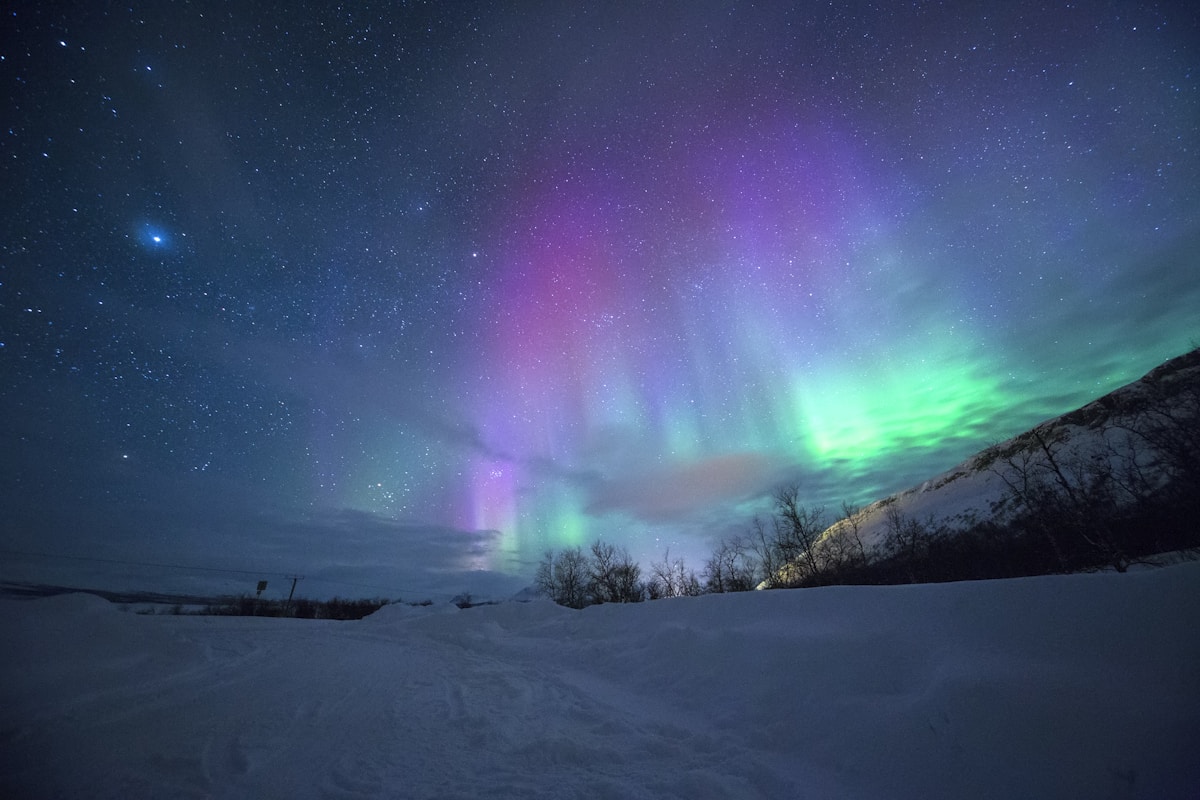
The aurora forms when charged particles emitted by the Sun — during so-called solar flares and coronal mass ejections (CMEs) — collide with the gases of the Earth's atmosphere along the magnetic field lines. High-altitude oxygen produces green and red colors, while nitrogen produces purple and blue tones. The intensity is measured by the KP Index, a scale from 0 to 9: above KP 4 it is visible to the naked eye in Lapland, above KP 5 also in Scotland and Denmark, above KP 7 even from northern Italy in optimal conditions.
When to Go: The Time Window
The aurora is only visible in the dark, so the ideal season runs from September to April. The months of June and July are practically impossible in Lapland and Iceland due to the white nights. The statistically best months are:
- September–October: enough darkness, temperatures are still bearable, fewer crowds
- December–January: very long nights (up to 20 hours of darkness in Lapland), but intense cold and possible fog/snow
- February–March: the experts' favorite period — the nights are still long, the sky is often more stable, and the temperatures less extreme
Plan at least 5-7 nights in the same area: the chances of clear skies on at least 2-3 nights increase enormously.
The Best Places to See the Aurora
- Tromsø, Norway: the "capital of the aurora". Excellent tourist infrastructure, organized tours every evening, ability to quickly leave the city in case of positive forecasts
- Abisko, Sweden: the microclimate of Lake Torneträsk creates a "blue hole" of clear sky that is statistically superior to the rest of Lapland. The Aurora Sky Station is at an altitude of 900m
- Levi/Saariselkä, Finland: great facilities with Aurora Cabins (glass-roofed cabins to watch while lying in bed)
- All of Iceland: anywhere away from the lights of Reykjavik. The Snæfellsnes peninsula and the Vík area are exceptional
- Greenland: for true adventurers. Absolute darkness, pristine skies, little tourist infrastructure
How to Read Forecasts: KP Index and SpaceWeatherLive
The SpaceWeatherLive.com website and the My Aurora Forecast app are the main tools. Check:
- Predicted KP: above 3 in Lapland means a good probability. Above 5 is excellent
- Cloud cover: use Yr.no (high-resolution local Norwegian forecasts) to find the clear sky window
- Bz southward: when the interplanetary magnetic field (IMF) is oriented south (negative Bz), solar particles enter the atmosphere more easily — boosting the aurora regardless of the KP
Camera Equipment for the Aurora
- Camera with manual mode: essential. Mirrorless or DSLR with a large sensor
- Fast wide-angle lens: f/1.8 or f/2.8 is ideal. Covers more sky and captures more light
- Sturdy tripod: exposures are 5-20 seconds. Impossible without a tripod
- Basic settings: ISO 1600-3200, f/2.8, 8-15 second exposure. Then adjust
- Warm spare batteries: the cold drains batteries in 30 minutes. Keep them warm in your pocket
Clothing: How to Survive Standing at -20°C for 3 Hours
The 3-layer system is fundamental: thermal base layer (merino or synthetic — never cotton), insulating mid-layer (down or fleece), waterproof and windproof outer shell. For hands and feet, the only truly effective solution are disposable chemical hand warmers (available in pharmacies) placed in gloves or boots. Invest in winter boots with insulation down to at least -30°C — it is not an exaggeration.
The golden rule of aurora hunting: never stop at the first location you find. Follow the clear sky forecasts even if it means driving 2 hours in the dark. It is always worth it.